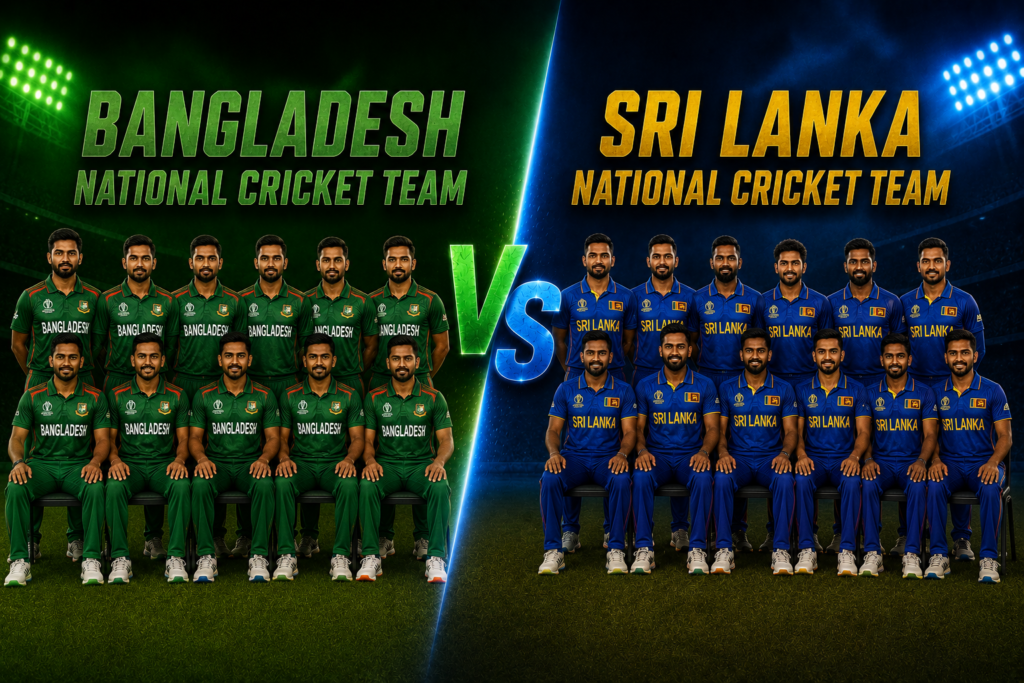
The Bangladesh National Cricket Team Vs Sri Lanka National Cricket Team Timeline is one of the most fascinating narratives in Asian cricket. It is a tale that stretches across decades, reflecting the rise of Bangladesh from an emerging cricket nation to a competitive international side, while also showcasing Sri Lanka’s transformation into a global powerhouse and World Cup-winning team.
Unlike rivalries built solely on trophies or political history, this contest represents cricket’s evolution in South Asia. Every encounter has revealed new chapters—whether it was Sri Lanka’s early dominance, Bangladesh’s struggle for recognition, or the Tigers’ gradual emergence as genuine challengers. From World Cup clashes to dramatic Asia Cup battles and memorable Test series, this timeline captures much more than wins and losses. It reflects changing eras, player generations, and the shifting balance of power in Asian cricket.
How the Rivalry Began: Early Encounters and Unequal Foundations
When Bangladesh and Sri Lanka first crossed paths in international cricket, the two nations occupied vastly different positions in the sport.
Sri Lanka had already established itself as a competitive international team after gaining Test status in 1981. By contrast, Bangladesh was still developing its cricketing structure and would not receive Test status until 2000.
Early Head-to-Head Context
| Period | Sri Lanka Status | Bangladesh Status |
| 1980s | Emerging Test nation | Associate member |
| Early 1990s | Competitive ODI side | Developing cricket nation |
| Late 1990s | World Cup champion | Rising Associate team |
The disparity was evident whenever the teams met. Sri Lanka possessed experienced players, structured domestic systems, and international exposure. Bangladesh was still learning the demands of elite cricket.
Yet these early encounters were important because they exposed Bangladesh’s players to higher standards and accelerated their development.
The significance of these matches can be understood only through context. Bangladesh’s cricket authorities frequently cited contests against stronger Asian nations as critical learning experiences. Sri Lanka, unknowingly, became one of the benchmarks Bangladesh would spend decades trying to reach.
The 1996 World Cup Era and Sri Lanka’s Rise to Global Power
No timeline involving Sri Lanka can ignore the transformational impact of the 1996 Cricket World Cup.
Sri Lanka revolutionized one-day cricket through aggressive batting strategies led by Sanath Jayasuriya and Romesh Kaluwitharana. Their World Cup triumph altered how limited-overs cricket was played globally.
Key Sri Lankan Milestones During This Era
| Year | Achievement |
| 1996 | Won Cricket World Cup |
| 1997 | Set then-world record Test score of 952/6 |
| 1998 | Asia Cup champions |
| 2000 | Established among elite cricket nations |
During this period, Bangladesh was still fighting for international recognition.
For Bangladesh, watching Sri Lanka’s rise offered a blueprint. Both nations lacked the traditional cricketing advantages enjoyed by countries such as Australia, England, and India. Sri Lanka’s success demonstrated that smaller cricket nations could challenge established powers.
The impact extended beyond scorecards. Many Bangladeshi administrators studied Sri Lanka’s development model, youth programs, and domestic cricket structures as examples worth following.
Thus, the rivalry’s early years carried educational value as much as competitive significance.
Bangladesh’s Test Status in 2000 Changed the Dynamic Forever
The biggest turning point in the Bangladesh National Cricket Team Vs Sri Lanka National Cricket Team Timeline arrived when Bangladesh became the tenth Test-playing nation in 2000.
This decision transformed occasional meetings into regular international contests.
Bangladesh’s Cricketing Transformation
| Year | Milestone |
| 1997 | ICC Trophy champions |
| 1999 | Defeated Pakistan in World Cup |
| 2000 | Awarded Test status |
| 2001 onward | Regular bilateral cricket |
With Test status secured, Bangladesh entered a demanding phase. They faced stronger teams regularly and suffered numerous defeats.
Sri Lanka frequently capitalized on Bangladesh’s inexperience. The gulf in class remained substantial, particularly in Test cricket.
However, repeated contests served an important purpose. Bangladesh’s young cricketers gained exposure against world-class players such as Muttiah Muralitharan, Kumar Sangakkara, Mahela Jayawardene, Chaminda Vaas, and later Angelo Mathews.
Every series became a classroom.
While the scorelines often favored Sri Lanka, Bangladesh gradually accumulated the experience necessary to compete at higher levels.
Test Cricket Timeline: Sri Lanka’s Dominance and Bangladesh’s Gradual Progress
The Test rivalry provides perhaps the clearest illustration of each team’s development.
For many years, Sri Lanka dominated with superior batting depth, spin bowling, and tactical maturity.
Test Head-to-Head Snapshot
| Category | Sri Lanka | Bangladesh |
| Early Era Wins | Dominant | Limited Success |
| Home Success | Strong | Improving |
| Away Success | Consistent | Occasional Breakthroughs |
| Series Victories | Majority | Few but Historic |
Sri Lanka’s batsmen often produced monumental scores against Bangladesh. Sangakkara, Jayawardene, and Dilshan repeatedly punished inexperienced bowling attacks.
However, Bangladesh slowly began narrowing the gap.
The emergence of players like Shakib Al Hasan, Tamim Iqbal, Mushfiqur Rahim, and Mominul Haque changed perceptions. These cricketers provided stability and resilience that earlier Bangladeshi sides lacked.
The draw secured in Galle in 2017, followed by Bangladesh’s famous Test victory in Sri Lanka during the same tour, marked a symbolic shift. It proved Bangladesh could compete in conditions traditionally favoring Sri Lanka.
That result remains one of the defining moments in the rivalry’s Test history.
ODI Battles: From One-Sided Contests to Genuine Competition
One-Day Internationals have produced the largest number of meetings between the two nations.
For nearly two decades, Sri Lanka controlled this format through superior experience and match awareness.
Evolution of ODI Competition
| Era | Rivalry Character |
| 1980s–1990s | Sri Lankan dominance |
| 2000–2010 | Competitive but one-sided |
| 2011–2017 | Bangladesh improving rapidly |
| 2018–Present | More balanced contests |
What changed was Bangladesh’s ability to build complete ODI teams.
Players such as Mashrafe Mortaza, Shakib Al Hasan, Tamim Iqbal, Mushfiqur Rahim, and Mahmudullah formed the backbone of a side capable of challenging any opponent.
Sri Lanka, meanwhile, entered a transitional period after the retirement of several legends.
The result was a far more competitive rivalry.
Bangladesh began winning bilateral series, competing strongly in ICC tournaments, and defeating Sri Lanka in pressure situations.
These victories carried symbolic weight because they represented years of gradual progress finally translating into results.
Asia Cup Encounters That Added Fire to the Rivalry
If bilateral series built the foundation, the Asia Cup intensified the rivalry.
Several Bangladesh-Sri Lanka matches in the tournament produced drama, controversy, and emotional storylines.
Memorable Asia Cup Moments
| Tournament | Notable Event |
| 2012 | Bangladesh’s breakthrough performances |
| 2016 | High-pressure T20 encounters |
| 2018 | Heated celebrations and rivalry moments |
| 2022 | Crucial knockout-style matches |
The 2018 Asia Cup became particularly memorable.
Bangladesh’s “Naagin Dance” celebrations and the reactions they generated added an emotional dimension rarely seen previously. While some viewed the celebrations as harmless fun, others interpreted them as signs of growing competitiveness and confidence.
These incidents demonstrated how much the rivalry had evolved.
Matches were no longer predictable contests between a giant and an underdog. They had become emotionally charged battles between two teams expecting to win.
That shift fundamentally altered the rivalry’s character.
The Players Who Defined the Bangladesh-Sri Lanka Timeline
Every great rivalry is remembered through its players.
Most Influential Figures
| Bangladesh | Sri Lanka |
| Shakib Al Hasan | Kumar Sangakkara |
| Tamim Iqbal | Mahela Jayawardene |
| Mushfiqur Rahim | Muttiah Muralitharan |
| Mashrafe Mortaza | Sanath Jayasuriya |
| Mahmudullah | Angelo Mathews |
Shakib Al Hasan’s all-round brilliance often gave Bangladesh a competitive edge.
Tamim Iqbal’s aggressive opening batting challenged Sri Lanka’s bowling attacks in ways few Bangladeshi batsmen had managed before.
For Sri Lanka, Sangakkara and Jayawardene represented batting excellence. Their consistency frequently proved decisive.
Meanwhile, Muralitharan’s dominance against Bangladesh remains one of the most influential individual narratives in the rivalry.
What makes these players significant is not merely their statistics but their impact on defining entire eras.
Many fans remember specific matches through the performances of these individuals rather than the final score alone.
Records and Statistical Milestones That Shaped the Rivalry
Statistics tell an important story when interpreted correctly.
Key Historical Records
| Category | Notable Achievement |
| Highest Individual Scores | Produced by elite Sri Lankan batters |
| Best Bowling Figures | Dominated by Sri Lankan spinners |
| Fastest Centuries | Recorded across ODI contests |
| Historic Bangladesh Wins | Primarily after 2010 |
| Longest Winning Streak | Held by Sri Lanka |
The numbers reveal two distinct phases.
The first phase was characterized by overwhelming Sri Lankan superiority.
The second phase reflects Bangladesh’s emergence as a genuine competitor.
This evolution makes the rivalry unique. It is not static. It reflects changing cricketing realities.
Many rivalries remain relatively balanced across generations. Bangladesh versus Sri Lanka instead showcases a dramatic shift in competitive balance over time.
That transformation is what gives the timeline historical significance.
Modern Era Trends: Why the Rivalry Is More Balanced Than Ever
The current chapter of the Bangladesh National Cricket Team Vs Sri Lanka National Cricket Team Timeline is arguably the most competitive.
Several factors explain this change.
First, Bangladesh now possesses experienced international cricketers capable of winning overseas matches.
Second, Sri Lanka has undergone significant rebuilding since the retirement of its golden generation.
Third, both teams increasingly rely on youth development and data-driven preparation.
Modern Rivalry Trends
| Factor | Bangladesh | Sri Lanka |
| Youth Pipeline | Strong | Strong |
| Spin Resources | Excellent | Excellent |
| Home Advantage | Significant | Significant |
| ICC Event Competitiveness | Improving | Improving |
The rivalry now feels less predictable.
Matches frequently hinge on tactical decisions, middle-order partnerships, and pressure management rather than sheer talent disparity.
For neutral fans, this unpredictability has made contests far more entertaining.
Why This Rivalry Matters in Asian Cricket History
The Bangladesh-Sri Lanka rivalry often receives less attention than India-Pakistan or India-Sri Lanka.
Yet historically, it may be one of the most meaningful stories in Asian cricket.
It documents how a developing cricket nation gradually closed the gap on an established power.
It illustrates the importance of infrastructure, player development, and long-term planning.
Most importantly, it offers hope to emerging cricket nations worldwide.
Bangladesh’s rise demonstrates that sustained investment can transform a struggling team into a respected international competitor.
Sri Lanka’s earlier journey showed exactly the same lesson.
In many ways, the rivalry represents cricket’s democratization—the idea that excellence is not restricted to traditional powers.
That broader significance makes the timeline valuable beyond simple wins and losses.
Conclusion
The Bangladesh National Cricket Team Vs Sri Lanka National Cricket Team Timeline is far more than a record of matches. It is a story of ambition, evolution, and changing cricketing fortunes across South Asia.
Sri Lanka began as the dominant force, armed with world-class players and international success. Bangladesh spent years learning, rebuilding, and growing. Over time, the competitive gap narrowed, producing a rivalry that is now respected throughout world cricket.
From Sri Lanka’s golden era to Bangladesh’s emergence as a formidable opponent, every chapter has contributed to one of cricket’s most compelling developmental stories. As both nations continue to produce talented new generations, the Bangladesh National Cricket Team Vs Sri Lanka National Cricket Team Timeline remains unfinished—and its most exciting chapters may still lie ahead.
Frequently Asked Questions
When did Bangladesh and Sri Lanka first play against each other in international cricket?
Bangladesh and Sri Lanka first met during the early years of Bangladesh’s emergence on the international stage. At that time, Sri Lanka was already an established Test nation while Bangladesh was still developing as a competitive cricketing force. These early encounters highlighted the gap between the teams but also provided valuable experience for Bangladesh’s cricketers. The matches laid the foundation for a rivalry that would become increasingly competitive over the following decades.
Why was Sri Lanka dominant against Bangladesh for so many years?
Sri Lanka enjoyed significant advantages in infrastructure, international experience, domestic cricket quality, and player development. By the time Bangladesh entered Test cricket in 2000, Sri Lanka had already produced world-class players and won the 1996 Cricket World Cup. Legends such as Muttiah Muralitharan, Kumar Sangakkara, and Mahela Jayawardene consistently delivered match-winning performances. Bangladesh needed years to develop a comparable talent pool and gain the experience required to compete consistently.
What is Bangladesh’s most significant achievement against Sri Lanka?
Among Bangladesh’s biggest accomplishments was securing a historic Test victory in Sri Lanka in 2017. The result demonstrated that Bangladesh could compete and win in conditions traditionally favoring Sri Lanka. Beyond that single victory, Bangladesh’s ability to win ODI series and compete strongly in Asia Cup tournaments signaled a broader transformation. These successes reflected years of development and helped establish Bangladesh as a respected cricketing nation.
Which players have had the greatest impact on this rivalry?
For Bangladesh, Shakib Al Hasan, Tamim Iqbal, Mushfiqur Rahim, Mashrafe Mortaza, and Mahmudullah have been highly influential. For Sri Lanka, Kumar Sangakkara, Mahela Jayawardene, Muttiah Muralitharan, Sanath Jayasuriya, and Angelo Mathews played crucial roles. These players defined entire eras through their performances and leadership. Their contributions shaped many of the rivalry’s most memorable matches and milestones.
How important are Asia Cup matches in this rivalry?
Asia Cup encounters have significantly increased the intensity of the rivalry. Unlike bilateral series, Asia Cup matches often carry knockout implications and greater regional attention. Several memorable moments—including dramatic finishes, emotional celebrations, and high-pressure performances—occurred during Asia Cup tournaments. These contests helped transform the rivalry from a one-sided matchup into a fiercely competitive regional battle.
Has the rivalry become more balanced in recent years?
Yes. Over the last decade, Bangladesh has significantly reduced the competitive gap. Improved domestic structures, experienced players, stronger pace attacks, and better spin resources have enabled Bangladesh to challenge Sri Lanka consistently. At the same time, Sri Lanka entered a rebuilding phase following the retirement of several legendary players. The result is a far more balanced rivalry where outcomes are increasingly difficult to predict.