Table of Contents
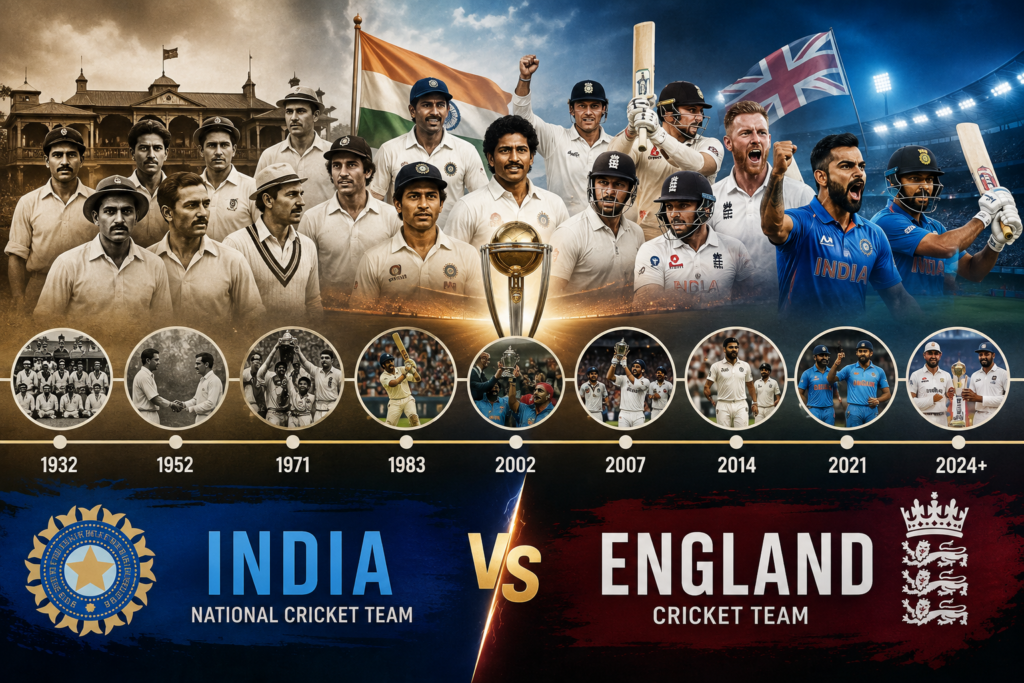
Cricket richest stories are often built over decades, and few rivalries capture the sport’s evolution better than the India National Cricket Team Vs England Cricket Team Timeline. Stretching from India’s debut Test match in 1932 to modern-day battles across all formats, this rivalry has witnessed colonial history, sporting transformation, legendary players, dramatic series, and unforgettable performances.
England introduced cricket to India during the British era, but over time the student became one of the sport’s dominant powers. What began as a one-sided contest has evolved into one of the most competitive and respected rivalries in international cricket.
The timeline between India and England is not merely a collection of matches. It reflects changing eras of cricket, shifting global power dynamics, and the rise of generations who redefined the game.
The Beginning of the Rivalry: India’s Historic Test Debut in 1932
The story starts at the iconic Lord’s Cricket Ground in June 1932. India played its first-ever Test match against England, officially entering international cricket.
Although England won by 158 runs, the match carried significance far beyond the result. India proved it could compete at the highest level. Led by C. K. Nayudu, the visitors displayed resilience and laid the foundation for future generations.
Early India vs England Test Results
| Year | Venue | Result |
| 1932 | Lord’s | England won |
| 1933-34 | India | England won series 2-0 |
| 1936 | England | England won series 2-0 |
These early encounters highlighted England’s superiority in experience and infrastructure. Yet they also introduced Indian cricket to the global stage.
The importance of these matches cannot be measured solely by wins and losses. They marked the birth of India’s international cricket journey.
Post-Independence Era: India Starts Finding Its Voice (1947–1970)
Following independence in 1947, Indian cricket began developing its own identity. Matches against England became opportunities to demonstrate national pride as much as sporting ability.
A major breakthrough came in 1952 when India secured its first-ever Test victory against England in Chennai.
Landmark Milestones After Independence
| Milestone | Year |
| First Test win vs England | 1952 |
| First Test series win vs England | 1961-62 |
| First major home dominance | 1960s |
India’s spin bowlers became increasingly influential during this period. The emergence of home conditions favoring spin allowed India to challenge England more effectively.
The rivalry was no longer entirely one-sided. England remained stronger overall, but India was steadily closing the gap.
The Turning Point: India’s Historic 1971 Series Victory in England
Every great rivalry has a defining moment. For India, that moment arrived in 1971.
Led by Ajit Wadekar, India traveled to England and achieved what many considered impossible: winning a Test series on English soil.
The decisive match at The Oval became legendary. Bhagwat Chandrasekhar produced one of the finest bowling spells in Indian cricket history.
1971 Series Snapshot
| Match | Venue | Result |
| 1st Test | Lord’s | Draw |
| 2nd Test | Manchester | Draw |
| 3rd Test | The Oval | India won |
Why 1971 Matters
- First Indian Test series win in England
- Shifted global perceptions of Indian cricket
- Inspired future generations
- Established India as a serious international competitor
Many historians consider this series the true beginning of India’s rise as a cricketing nation.
The Golden Era of Individual Battles (1970s–1990s)
The following decades produced some of cricket’s most memorable contests.
England featured stars such as Ian Botham, David Gower, and Graham Gooch.
India countered with icons like Sunil Gavaskar, Kapil Dev, and later Sachin Tendulkar.
Key Individual Performances
| Player | Team | Achievement |
| Sunil Gavaskar | India | Multiple centuries vs England |
| Ian Botham | England | Dominant all-round performances |
| Kapil Dev | India | Match-winning spells |
| Graham Gooch | England | Massive Test scores |
These years transformed the rivalry into a contest of cricketing styles—England’s traditional approach versus India’s technical brilliance and spin mastery.
India National Cricket Team Vs England Cricket Team Timeline in One Glance
The rivalry’s evolution becomes clearer when viewed chronologically.
Major Timeline Events
| Year | Event |
| 1932 | India plays first Test |
| 1952 | India records first Test victory |
| 1961-62 | India wins first Test series |
| 1971 | India wins first series in England |
| 1983 | India becomes world champion |
| 2002 | NatWest Final victory |
| 2007 | India wins Test series in England |
| 2011 | England reaches No.1 Test ranking |
| 2021 | India leads series before postponement |
| 2024-25 | Rivalry continues in modern era |
This timeline reflects how the balance of power gradually shifted from England’s dominance to a much more even contest.
The NatWest Final of 2002: A One-Day Classic
Few limited-overs matches carry the emotional weight of the NatWest Final at Lord’s.
Chasing 326, India appeared out of contention before remarkable innings from Yuvraj Singh and Mohammad Kaif changed everything.
NatWest Final Highlights
| Team | Score |
| England | 325/5 |
| India | 326/8 |
The image of Sourav Ganguly celebrating from the Lord’s balcony became one of cricket’s most iconic moments.
Why was this match important?
Because it signaled the arrival of a fearless Indian generation willing to challenge traditional powers on their own turf.
Test Cricket’s Modern Chapter: Tendulkar, Cook, Anderson and Kohli
The 2000s and 2010s introduced another fascinating phase.
India produced stars such as:
- Sachin Tendulkar
- Rahul Dravid
- Virender Sehwag
- MS Dhoni
- Virat Kohli
England countered with:
- Andrew Strauss
- Kevin Pietersen
- Alastair Cook
- Stuart Broad
- James Anderson
Most Test Matches in the Rivalry
| Player | Team | Matches |
| James Anderson | England | Among highest appearances |
| Alastair Cook | England | Long-serving performer |
| Sachin Tendulkar | India | Extensive record |
| Virat Kohli | India | Modern era leader |
This period elevated the rivalry’s global profile. Television audiences expanded dramatically, and every India-England series became a major international event.
Home Advantage and Why Conditions Shape This Rivalry
One of the most intriguing aspects of the rivalry is how dramatically conditions affect results.
Comparative Home Records
| Factor | India | England |
| Pitch Nature | Spin-friendly | Seam-friendly |
| Weather | Dry and hot | Cool and cloudy |
| Key Bowling Strength | Spin | Swing and seam |
India historically dominates at home due to world-class spinners and difficult batting conditions for visitors.
England traditionally enjoys success on green pitches where swing bowling becomes highly effective.
This contrast ensures every tour feels like a fresh challenge rather than a predictable series.
Statistical Comparison of the Rivalry
Numbers alone cannot tell the entire story, but they reveal the rivalry’s competitive evolution.
Overall Test Rivalry Snapshot
| Category | India | England |
| First Test | 1932 | 1932 |
| Total Encounters | 130+ | 130+ |
| Home Dominance | Strong | Strong |
| Overseas Success | Improving | Historically strong |
Format Comparison
| Format | Competitive Balance |
| Tests | Closely contested |
| ODIs | India slight edge in modern era |
| T20Is | Highly competitive |
The trend is clear: the gap that existed in the early decades has largely disappeared.
The Rise of the Bazball Era and India’s Modern Challenge
Recent years have introduced England’s aggressive “Bazball” philosophy under coach Brendon McCullum and captain Ben Stokes.
England’s attacking style has transformed Test cricket strategy.
India, meanwhile, continues producing elite talent through a strong domestic structure and the influence of the Indian Premier League.
Modern Trends
| Trend | Impact |
| Bazball | Faster scoring rates |
| IPL influence | Better white-ball skills |
| Data analytics | Tactical improvements |
| Fitness standards | Longer player careers |
The rivalry today combines tradition with innovation, making every series tactically fascinating.
Why the India-England Rivalry Remains Special
Unlike some rivalries driven by hostility, India versus England is built on history, respect, and sporting significance.
Several factors make it unique:
- Shared cricketing heritage
- Nearly a century of competition
- Multiple generations of legends
- Historic venues
- Massive global audiences
- Competitive balance across formats
Every era has contributed its own chapter, from Nayudu and Gavaskar to Tendulkar and Kohli, and now to a new generation shaping the future.
The rivalry continues to evolve while remaining deeply connected to cricket’s past.
Conclusion
The India National Cricket Team Vs England Cricket Team Timeline is more than a record of matches and statistics. It is the story of cricket’s transformation across nearly a century. From India’s first Test appearance at Lord’s in 1932 to modern battles featuring advanced analytics, aggressive tactics, and global audiences, the rivalry has consistently produced defining moments for the sport.
What began as a contest between an established cricketing power and a newcomer has evolved into one of international cricket’s most respected rivalries. The India National Cricket Team Vs England Cricket Team Timeline remains a living narrative—one that continues to add memorable chapters with every series played.
Frequently Asked Questions
When did India first play England in Test cricket?
India played its first official Test match against England at Lord’s in June 1932. This was India’s debut in international Test cricket. Although England won the match, it marked a historic moment because India became one of the earliest nations to participate in Test cricket. The occasion laid the foundation for a rivalry that would span generations and eventually become one of the most significant contests in world cricket.
When did India record its first Test win against England?
India secured its first Test victory over England in 1952 in Chennai. The win represented a major breakthrough for Indian cricket. Until then, England had largely dominated the contests. The victory demonstrated that India was capable of competing against established cricketing powers and helped boost confidence within the national team during its developmental years.
What was India’s most famous Test series win in England?
Many historians consider the 1971 Test series victory in England to be India’s most important overseas achievement. Led by Ajit Wadekar, India won the final Test at The Oval and secured a historic series triumph. The achievement transformed perceptions of Indian cricket internationally and inspired future generations of players.
Why is the 2002 NatWest Final considered iconic?
The NatWest Final remains one of the greatest ODI matches ever played. India successfully chased 326 after appearing to be in trouble early in the innings. Yuvraj Singh and Mohammad Kaif produced remarkable performances, while Sourav Ganguly’s celebration at Lord’s became a defining image of modern Indian cricket. The victory symbolized India’s growing confidence on the world stage.
Who has had the biggest impact on this rivalry?
Many players have shaped the rivalry across different eras. For India, Sunil Gavaskar, Kapil Dev, Sachin Tendulkar, MS Dhoni, and Virat Kohli stand out. For England, Ian Botham, Graham Gooch, Alastair Cook, Stuart Broad, and James Anderson have left lasting legacies. Each generation has contributed memorable performances that enriched the rivalry.
How has the rivalry changed in modern cricket?
Modern India-England contests are far more balanced than early encounters. Improved coaching, analytics, fitness programs, and professional leagues have strengthened both teams. Today’s rivalry extends across Tests, ODIs, and T20Is, making it one of the most complete and commercially significant rivalries in international cricket.
Which team has historically dominated the rivalry?
England held a clear advantage during the early decades because of greater experience and cricketing infrastructure. However, India’s rise since the 1970s has significantly narrowed the gap. In contemporary cricket, results often depend on conditions, making the rivalry one of the most evenly matched among major cricket nations.